Fri, September 22, 2006
TV Martí director: Ethics debate is needed
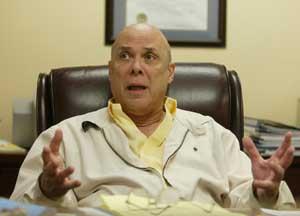
TV Martí director: Ethics debate is needed
The director of Radio and TV Martí calls for a national debate on the ethics of hiring journalists from private media to freelance for U.S. media, including Voice of America.
BY OSCAR CORRAL
Office of Cuba Broadcasting Director Pedro Roig, who oversees TV and Radio Martí, said Thursday that he runs his operation ethically and wants to start a national debate on whether journalists who work for news companies and also freelance for the government have a conflict of interest.
Referring to The Miami Herald's Sept. 8 report that named several local journalists who had also been receiving payments from the U.S. government for their work at TV and Radio Martí, Roig said his entity has nothing to hide because its very goal is to promote open debate on the island about Cuba's future.
''I believe in the right that all human beings have to criticize their government without fear of repression,'' he said. ``In the end there's one message, for Cubans to understand that in a free society, different problems and themes are discussed, passionately, but at the end of the day, no one is imprisoned, and no one is going to get an act of repudiation done against them. . . . We have the right to make mistakes, like The Herald has a right to make a mistake.''
At least 10 journalists have received U.S. payments from Radio and TV Martí to provide programming or content, over the last five years, a preliminary examination of federal records found. The Miami Herald Media Co. dismissed two El Nuevo Herald reporters and severed ties with a longtime freelancer for violating the company's ethics policy on conflicts of interest soon after the information about the payments surfaced.
The firings and the subsequent coverage of the payments in the local, national and international media have fired up emotions among some Cuban exiles and journalists throughout the United States.
''I'm initiating a debate . . . in the United States: Should this be done or not?'' Roig said.
Many Cuban exiles have expressed that there is no conflict of interest and that the reporters should not have been dismissed.
The South Florida Chapter of the Society of Professional Journalists entered the fray Thursday, issuing a statement condemning government payments to journalists and endorsing the Miami Herald Media Co.'s decision to uphold its ethics policy.
'Journalists' decisions to accept payment from [the government] runs contrary to the SPJ Code of Ethics, contradicts the standard of independent journalism and undermines the public's confidence in the credibility of the news media,'' the journalism group noted.
Roig spoke to The Miami Herald at the Jorge Mas Canosa Building, the headquarters of Radio and TV Martí in West Dade. He said it's the first interview he has granted since the report, which he criticized for questioning the integrity of journalists he holds in high esteem.
He categorized the article as ''infamy'' and took issue with the headline and photos of the journalists. ''I think it has criminalized, or has demonized, people -- journalists of impeccable conduct, very good people,'' Roig said.
In defending the payments to journalists, Roig cited a strict ''firewall'' that exists between Radio and TV Martí and the policies of any president.
''We are totally independent of the tenant of the White House,'' he said. ``When contributors come, we've never told them what they have to do or say.''
Roig disagreed with comparisons initially drawn by some journalism ethics experts -- Kelly McBride, Ethics Group Leader at the Poynter Institute, and Jay Black, editor of Mass Media Ethics -- to the case of journalist Armstrong Williams.
In the Williams affair, the U.S. Education Department, through the Ketchum Public Relations Firm, paid Williams $240,000 to talk about the Bush administration's No Child Left Behind Act during his nationally syndicated television show.
Williams' contract with the government, USA Today reported, required Williams ``to regularly comment on the NCLB during the course of his broadcasts.''
An example of a contract between a newspaper journalist also moonlighting for Radio Martí requires that he ``provide services in support of Radio News . . . for combination services: original writing; voicing; and researching topics to be discussed.''
Radio and TV Martí, with a $37 million budget this year, are U.S. government programs created to promote democracy and freedom in communist Cuba. Their programming cannot be broadcast within the United States because of anti-propaganda laws.
Roig said he believes it's common for journalists in Washington to get paid by the government through the Voice of America.
''It was common practice in Washington where hundreds of journalists have participated [in VOA and other U.S. Broadcasts],'' he said.
Larry Hart, communications coordinator for the Broadcasting Board of Governors, said Thursday that ''many, many, many'' high-profile Washington journalists have participated in VOA and other U.S.-sponsored broadcasts. He said he could name only ''seven or eight,'' some retired from the 1980s, and some still active, because he had not done an extensive review.
One of the journalists Hart identified, according to a recent report in El Nuevo Herald, was Hartford Courant Bureau Chief David Lightman. The Courant ordered Lightman to stop participating in VOA broadcasts.
''It can certainly be seen as a conflict, and that's why we're stopping it,'' Clifford Teutsch, The Courant's editor, said in a statement published in the newspaper.
Thursday's statement from SPJ, which with more than 100 members in South Florida and more than 10,000 nationwide is the largest journalists' association in the United States -- also addresses the cultural differences that may exist between journalists who move here from other countries and those educated and trained in the United States.
''Journalists in South Florida, and increasingly across the United States, come from countries with stronger traditions of ideological or advocacy journalism than we have in the United States,'' the SPJ statement said.
"While we respect other forms of communication, the Society long ago resolved that professionalism requires journalists be autonomous from those in power, especially the government.''